
Google I/O and the leap to full agentic search
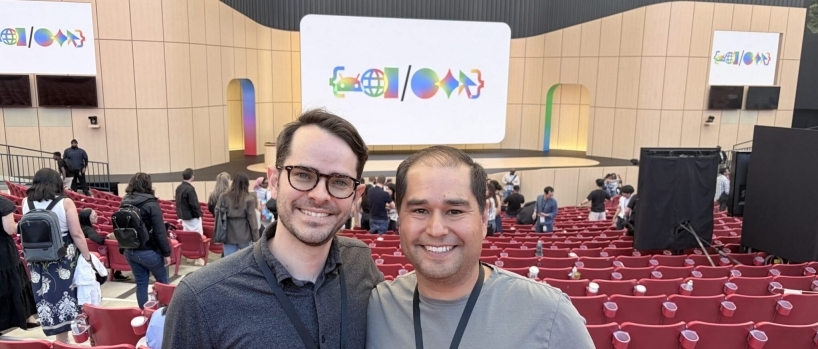
What Sundar, Liz, and Josh Revealed About the Future of AI Discovery
Google I/O has always been a signal event for how we think about the future of search. It was not simply a showcase of new models, new product features, or faster AI infrastructure. It was a clear statement about how Google believes people will search, discover, understand, and act on information in the AI era.
Across the keynote, three speakers in particular shaped the story of where Google is headed: Sundar Pichai, Liz Reid, and Josh Woodward. Each focused on a different layer of the same transformation. Sundar framed the scale of Google’s AI infrastructure and the evolution of Search into a more conversational experience. Josh showed how personal agents like Gemini Spark will begin working across a user’s digital life. Liz explained how Google Search itself is being rebuilt as an AI-native, agentic discovery system.
Taken together, the message was unmistakable: Google is no longer positioning AI as an add-on to Search. Google is positioning Search as the AI system.

For more than two decades, Search has been defined by the familiar behavior of typing a query into a search box, receiving a list of results, and clicking through to a website. Google I/O showed a very different future. In this new model, users do not simply search. They ask more complex questions. They continue conversations. They upload images, files, and videos. They expect Google to synthesize information, build custom interfaces, monitor changes, and eventually take action on their behalf.
For SEO and marketing teams, this event marks the most important changes to organic discovery. It challenges the industry to move beyond rankings and traffic alone, and toward a broader model of AI visibility, content extractability, multimodal expectations, and agent-driven discovery.
Sundar’s Message: Search Is Becoming an Ongoing Conversation
Sundar opened the keynote by placing Google’s AI transformation in the context of scale. He described the company’s decade-long shift toward being AI-first and framed the current moment as one of “hyper progress.” The numbers he shared were meant to communicate more than technical momentum. They showed that AI is no longer experimental behavior at the edge of Google’s products. It is becoming the central usage pattern across the company.
He noted that Google is now processing 3.2 quadrillion tokens per month, up from 480 trillion the year before, and that more than 8.5 million developers are building with Google’s models each month. He also stated that Google has 13 products with more than one billion users, and that Gemini models are becoming a key reason people are using those products more deeply.
But the most important part of Sundar’s message for search marketers was not the infrastructure story. It was how he described Search itself.
Sundar said that Search is “bringing the benefits of generative AI to more people than any other product in the world.” He then shared that AI Overviews now have more than 2.5 billion monthly users, while AI Mode has already surpassed 1 billion monthly users. He described AI Mode as “our biggest upgrade to Search ever” and made one of the most important statements of the entire keynote: Search is becoming “less about individual queries” and more like “an ongoing conversation.”
That quote captures the strategic shift perfectly.
Traditional SEO has largely been built around the individual query. Teams research keywords, map them to pages, optimize titles and headings, measure rankings, and evaluate click-through rates. But if Search becomes an ongoing conversation, then the unit of optimization changes. The goal is no longer simply to rank for a query. The goal is to be present, useful, and trusted throughout a user’s evolving information journey (across modalities).
Sundar also reinforced this shift through examples like Ask YouTube and Docs Live. Ask YouTube was positioned as a conversational layer that can summarize videos, surface relevant clips, remember context, and support follow-up questions. I have said for over two years that Video and Audio is coming to AI discovery.
These examples matter because they show how Google is driving the connection of search to the multimodal world of video and contextual assets. As users of the web we no longer move from a search result to a webpage to a document to an outcome. The AI system is increasingly orchestrating the entire journey.
So what will happen next?
We are reaching the end of “one query, one page” search
Sundar’s framing of Search as an “ongoing conversation” is a direct challenge to the old model of query-to-page optimization. The future of SEO will depend on how well a brand can support multi-step discovery journeys, not just whether it can win a single ranking position.
Josh’s Message: Personal Agents Will Change How People Navigate the Web
If Sundar explained the scale and ambition of Google’s AI transformation, Josh Woodward showed what it looks like inside a user’s daily life.
His demo of Gemini Spark was one of the clearest examples of Google’s agentic future. Spark was introduced as a personal AI agent that helps users manage tasks, coordinate information, and operate across their digital environment. The key idea was not that Spark can answer questions. It was that Spark can keep working after the user stops interacting with it.
Josh showed Spark compiling information from Docs, email, and chats to draft an internal update. He demonstrated how it could manage RSVPs for a block party, maintain a live Google Sheet, send reminder drafts, generate a slide deck, and pull relevant details from a homeowners association file in Google Drive.
The most important phrase from Josh’s demo was that Spark lets users “throw tasks over your shoulder” and have the agent catch them and run with them. That is a very different model from traditional search behavior. Instead of asking Google for a result and then doing the work manually, as users we can give an instruction and expect the system to coordinate the work in the background.
This has major implications for search and discovery.
For years, marketers have optimized for users who are actively browsing. But agents introduce a new kind of intermediary. Increasingly, consumers may not visit a website directly to compare options, research a product, find an event, book a reservation, or evaluate a service. Their agent may do that research for them.
That means the brand’s audience is no longer only the human user. Our future of optimization will be focused on how we share the AI agents acting on the user’s behalf.
Spark also shows that discovery is becoming more personalized. The agent can draw on email, calendar, Drive, preferences, documents, and user history. That means the same broad search intent may produce very different outcomes depending on the person, their context, and the agent’s understanding of their life.
For SEO teams, this creates a new challenge: there may be fewer universal search journeys and more personalized, agent-mediated discovery paths.
Your next visitor may be an agent, not a person, but the conversion might still happen
Josh’s Gemini Spark demo shows a future where AI agents research, compare, organize, and act for users. SEO and marketing teams will need to optimize not only for human readers, but also for AI systems that retrieve information, compare options, and decide what deserves to be surfaced.
Liz’s Message: Google Search Is Becoming AI Search
Liz Reid’s portion of the keynote was the most direct explanation of how Google Search itself is changing.
She began with a simple but important observation: people bring billions of questions to Search every day, and those questions are increasingly personal, specific, and complex. She explained that Google has been working to bring together “the best of a search engine with the best of AI,” beginning with AI Overviews and continuing with AI Mode.
Then she made the defining statement of the Search keynote:
“Google Search is AI search through and through.”
This is the line that marketers should pay attention to.
It means Google does not see AI as a separate search mode forever. It sees AI as the architecture of Search itself. AI Overviews, AI Mode, multimodal inputs, follow-up questions, agentic tools, and generated interfaces are converging into one unified search experience.
Liz explained that AI Mode has surpassed more than 1 billion monthly users and that AI Mode queries are more than doubling every quarter. She also noted that Search queries reached an all-time high last quarter, because users are learning they can ask more detailed, specific questions.
That is an important counterpoint to the idea that AI simply reduces search behavior. Google’s argument is that AI expands search behavior. When users believe Search can handle more complexity, they bring more complex tasks to it.
Liz illustrated this with a shift from simple keyword searches to more natural, specific requests. Instead of searching for “nearby hikes,” a user might ask Google to build a dog-friendly hiking itinerary with great views, lunch options, and convenient parking.
That example shows exactly why traditional keyword models are under pressure.
The future of search queries will be longer, more conversational, and more task-oriented. They will include constraints, preferences, context, and desired outcomes. Users will not always know the perfect search phrase. Google will help them form it.
That is why Liz also introduced the new intelligent search box, which she described as the “biggest upgrade” to the iconic search box since its debut more than 25 years ago. This new search box expands with the user’s curiosity, provides AI-powered suggestions, and supports questions across text, images, files, and videos.
This is a major product and behavioral shift. The search box is no longer just a place where users type keywords. It becomes an AI-guided prompt interface.
For marketers, this changes the nature of demand. Google will not only respond to demand; it will help shape how demand is expressed. This means SEO strategies must become more deeply aligned with user problems, decision journeys, and information needs, rather than just keyword lists.
Google is now shaping the question, not just answering it
The intelligent search box moves Google deeper into the intent-formation process. Marketers should expect fewer static keyword journeys and more AI-assisted query expansion, where Google helps users ask richer, more specific questions.
Search Agents Will Monitor the Web for Users
One of Liz’s most important announcements was the introduction of Search Agents.
She said that Google is entering “the era of search agents,” where users can create and manage multiple AI agents for different tasks directly inside Search. These agents can work in the background, monitor information, track changes, and notify users when something relevant happens.
This is a massive change.
Traditional search is reactive. A user has to return to Google whenever they want new information. Search agents make discovery persistent. The user can ask Google to monitor something over time and surface updates when they matter.
Liz gave examples across finance, apartment hunting, sneaker releases, shopping, social content, forums, blogs, and real-time data sources. In the finance example, the agent could monitor biotech stocks with specific cash flow and debt criteria, connect to real-time finance data, and send synthesized updates when conditions changed. In the apartment example, a user could brain dump criteria around location, natural light, and availability, and the agent would continuously scan the web across sites, social platforms, and forums.
This introduces a very different kind of search visibility.
The question is no longer only, “Can we rank when someone searches today?”
The new question is, “Can our information be discovered by an agent that is continuously monitoring the web on behalf of a user?”
That means freshness, structure, and credibility become even more important. Agents need to know what changed, why it matters, and whether the source is reliable. Brands that publish timely, well-structured, authoritative information may gain new forms of visibility inside these agentic workflows.
Liz also made a notable point that these agents can help “websites and creators get fresh content discovered by people who really care about it when it matters most to them.”
That line is important because it shows how Google wants to position agentic discovery as additive to the web, not just extractive from it. The promise is that agents can connect users to more relevant, timely content. But the practical reality for marketers is that the competition for inclusion inside agent updates will be intense.
Callout: Freshness becomes an agentic ranking factor
Search agents will monitor the web continuously. That means stale pages, outdated claims, and slow publishing cycles will become more costly. Brands that can provide timely, structured updates may become more useful to AI agents.
Search Will Build Custom Experiences, Not Just Return Results
Liz Reid’s also highlighted that Google Search is moving beyond traditional results to generating custom, AI-native experiences, such as dynamic layouts, interactive widgets, and simulations, using Gemini 3.5 Flash and Anti Gravity. This redefines the search result, as Google can now plan and execute the ideal response from scratch, creating a custom interface for the user’s question. The key takeaway for SEO is that the strategic focus must shift from simply owning the interface, like creating proprietary calculators or planners, to becoming the trusted data source, methodology, or authority that powers these AI-generated experiences. Our calculators and tools will now be native to Google Search!
The second major theme is that AI Search will “Collapse Discovery and Action,” as Google aims to help users not just understand information but also act on it, enabling them to “find it, check it, book it, buy it, or more”. This shift is supported by agentic commerce features, where AI agents are designed to assist with tasks like product research, price monitoring, compatibility checks, and purchase execution under user-defined boundaries.
These changes have major implications for marketers. For custom experiences, brands must focus on ensuring their data, expertise, and authority are retrieved and used within these generated experiences, even if a click-through doesn’t occur. For e-commerce, optimization becomes “agent optimization,” requiring product information to be complete, accurate, and structured enough for AI systems to use in their decision-making process, often shaping brand preference before the user ever visits a merchant site.
Final Thought: Google Is Rebuilding Discovery Around AI Agents
Google I/O made clear that the future of Search is not simply more AI answers.
It is a new discovery architecture.
Sundar showed that Google is operating at massive AI scale and believes Search is becoming an ongoing conversation. Josh showed that personal agents will work across a user’s digital life and complete tasks in the background. Liz showed that Google Search itself is becoming an AI-native, agentic system that can reason, monitor, generate, and act.
For marketers, this is the beginning of a new era.
The brands that win will not simply be the ones that publish the most content or rank for the most keywords. They will be the brands that become trusted inputs into AI discovery systems.
Search and AI Models will need want:
Easy to extract.
Easy to cite.
Easy to compare.
Easy to recommend.
And easy for agents to act on.
The future of search is not just about being found. It is about being useful enough for Humans with the power of AI.
Published on May 19, 2026
Last Updated on May 27, 2026
Your buyers are already asking AI who to trust. Let's make sure they find you.


Continue reading

Why “Brand” Is Becoming the Real Battleground in AI Search

